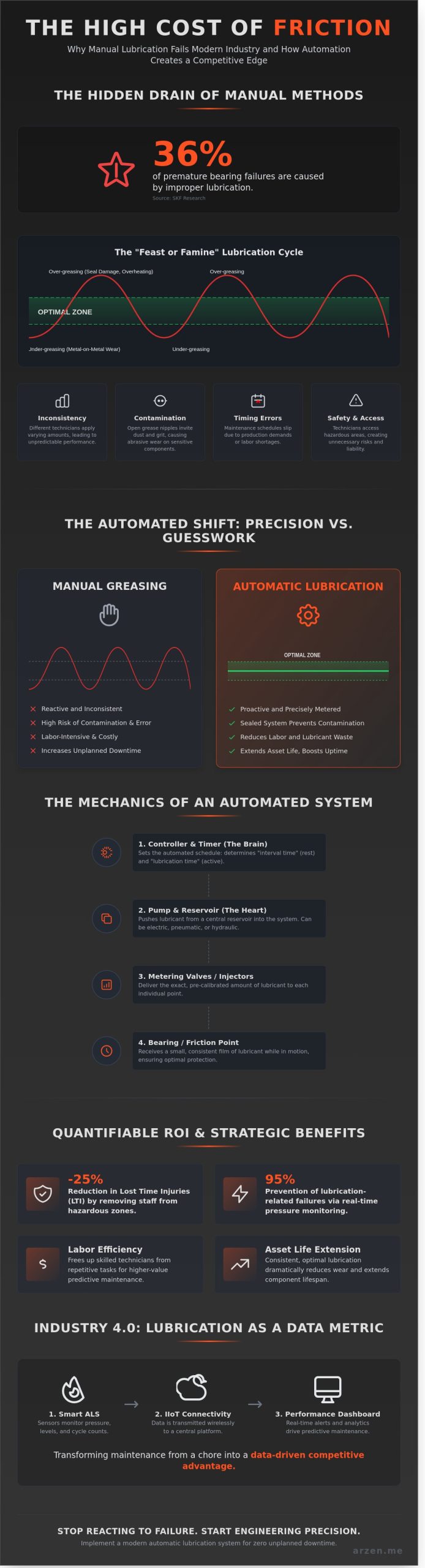
Research by SKF confirms that 36% of premature bearing failures stem directly from improper lubrication. In a high-output environment, this isn’t just a maintenance oversight. It’s a structural leak in your P&L. Manual greasing is slow, inconsistent, and often dangerous. You’ve seen the results: frequent downtime, rising labor costs, and the persistent risk of human error in your most critical zones. Relying on a technician’s intuition for machine health is a strategy from the past.
It’s time to stop reacting to failure. Implementing a modern automatic lubrication system shifts the paradigm from manual labor to automated precision. We’ll show you how to transform friction from a hidden cost into a data-driven performance metric that fuels your bottom line. This guide provides the 2026 roadmap for achieving zero unplanned downtime and reduced maintenance spend. We’ll explore how to integrate real-time lubrication data into your Industry 4.0 dashboards, turning maintenance from a chore into a competitive advantage. Let’s build a future where your machinery operates with absolute, uninterrupted intelligence.
Key Takeaways
- Eliminate the “Friction Tax” by replacing manual inconsistency with precision-engineered delivery.
- Learn to calibrate an automatic lubrication system for peak efficiency using cycle logic and interval timing.
- Select the optimal architecture for your operations, comparing high-pressure progressive systems with heavy-duty dualine setups.
- Quantify the strategic ROI of automation through labor efficiency, lubricant optimization, and asset life-extension.
- Integrate Industry 4.0 connectivity to transform lubrication into a real-time, data-driven performance metric.
The Friction Tax: Why Manual Lubrication Fails Modern Industry
Friction is more than a physical force. In modern manufacturing, it’s a hidden financial drain. We call this the Friction Tax. It represents the accumulated costs of unplanned downtime, premature component wear, and wasted labor. An automatic lubrication system (ALS) is the strategic response to this tax. It’s not a simple upgrade. It’s a precision-engineered delivery mechanism that replaces human guesswork with mathematical certainty.
Manual lubrication relies on a feast or famine cycle. A technician applies a large volume of grease at widely spaced intervals. The bearing starts flooded, then slowly starves until the next maintenance cycle. This creates a volatile environment where friction levels fluctuate wildly. An automatic lubrication system eliminates this peak-and-valley profile. It delivers small, metered amounts of lubricant while the machinery is in motion. This ensures a consistent, protective film that stays within the optimal zone at all times.
The High Cost of Human Error
Precision is the enemy of the manual grease gun. Industry data indicates that 50% of bearing failures stem directly from improper lubrication. The damage happens at both ends of the spectrum. Over-greasing creates internal pressure that destroys seals and causes churning, which leads to overheating. Under-greasing allows metal-on-metal contact, leading to rapid abrasive wear. Manual lubrication is a variable in an equation that requires a constant.
- Inconsistency: Different technicians apply different amounts of pressure and volume.
- Contamination: Open grease nipples invite dust and grit into the most sensitive parts of the machine.
- Timing: Maintenance schedules often slip due to labor shortages or production demands.
Safety and Accessibility Challenges
Plant logistics often turn simple maintenance into a high-risk operation. Lubricating 140 points across a sprawling industrial site is a logistical nightmare. Many of these points reside in confined spaces, at extreme heights, or inside high-temperature zones. Forcing a technician to access these areas while machines are running is a liability. It’s a safety compromise that modern standards no longer accept.
Centralized automation changes the safety profile of the entire facility. By moving the lubrication interface to a single, accessible location, companies see a 25% reduction in Lost Time Injuries (LTI) related to maintenance. Automation removes the human element from the hazard zone. It transforms a dangerous, repetitive task into a monitored, high-level strategy. In environments with high pressure or toxic fumes, this isn’t just about efficiency. It’s about survival.
The Mechanics of Precision: How an Auto Greaser Operates
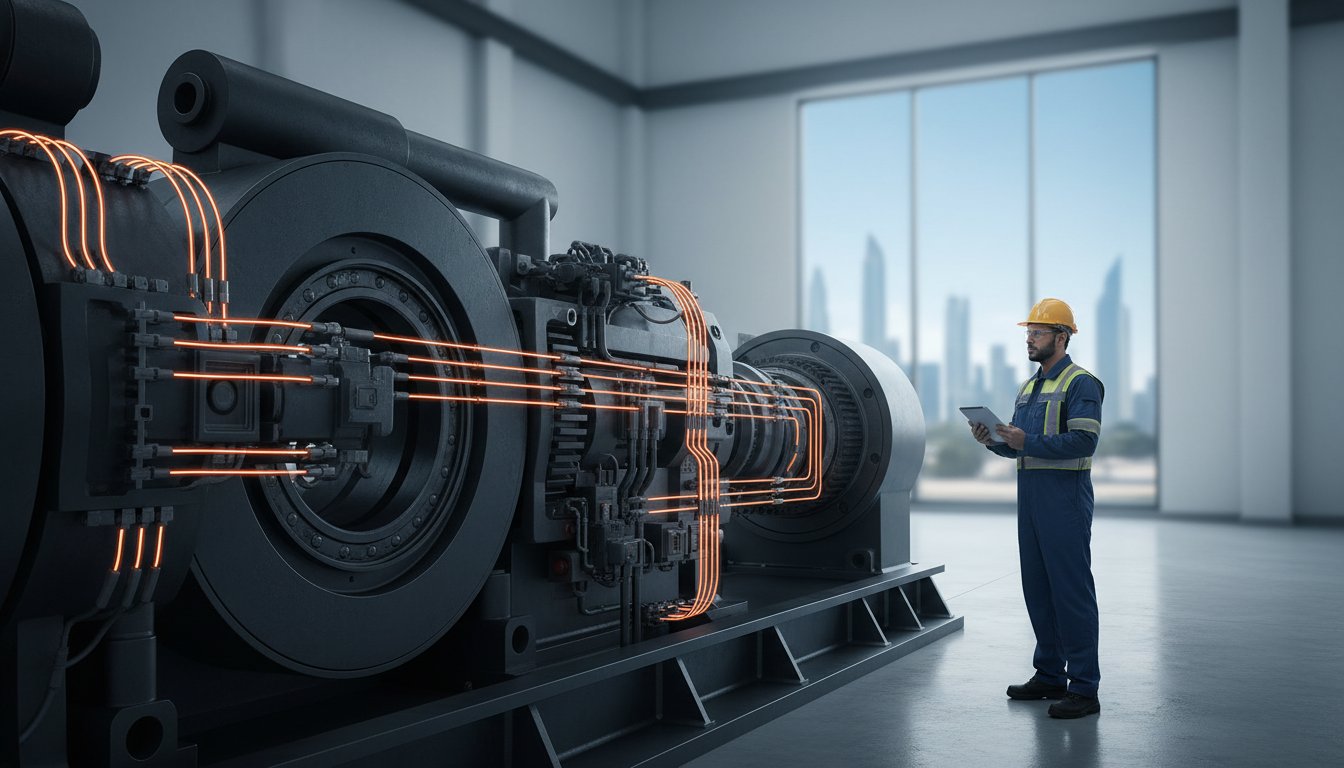
Precision isn’t an accident. It’s engineered. An automatic lubrication system functions as a synchronized ecosystem where timing and volume meet mechanical necessity. The logic is simple but absolute. The cycle operates on two constants: interval time and lubrication time. Interval time represents the rest period, often calculated based on machine hours or cycles. Lubrication time is the active phase. This cadence prevents the “starve or flood” cycle common in manual greasing, where bearings receive too much grease once a week and none for the remaining six days.
The system’s integrity relies on the pressure differential between the main line and feed lines. The main line acts as the high-pressure artery, moving lubricant from the reservoir. Feed lines serve as the capillaries, delivering the final dose to the friction point. Modern setups utilize a closed-loop design. Pressure switches and cycle sensors provide real-time feedback to the controller. If a line breaks or a point blocks, the system identifies the drop in backpressure immediately. This feedback loop prevents 95% of lubrication-related bearing failures by ensuring the machine doesn’t run dry.
The Pump and Controller: The Brain of the System
Power defines the pump’s application. Electric pumps, typically 24V DC, dominate mobile equipment and heavy machinery. Pneumatic systems utilize factory air at 6 to 8 bar for stationary industrial plants. Hydraulic variants leverage existing machine power for high-pressure needs reaching 300 bar. Smart controllers manage this energy. They allow for adjustments down to the milliliter per point, ensuring zero waste. Integrated ultrasonic sensors monitor reservoir levels. If grease drops below a 10% threshold, the system alerts the operator. It’s about proactive control, not reactive maintenance.
Metering Valves and Injectors: Delivering the Dose
Precision happens at the point of contact. Positive Displacement Injectors (PDI) act as miniature pistons. They fire a predetermined volume regardless of temperature fluctuations or grease viscosity. Divider blocks split flow with mathematical accuracy using a progressive sequence where each piston must move before the next can activate. Volumetric precision is the delivery of a repeatable, measured quantity of lubricant, often as small as 0.02cc, to every friction point. This level of accuracy is essential for optimizing your industrial strategy and extending component life cycles.
- Electric Pumps: Best for consistent, stand-alone mobile operation.
- PDI Injectors: Ideal for systems requiring independent point adjustment.
- Divider Blocks: Perfect for harsh environments where series-monitoring is required.
- Cycle Sensors: Essential for 100% verification of lubricant delivery.
Modern automatic lubrication system designs prioritize this “less, but more often” approach. By delivering small, frequent doses while the machine is in motion, the lubricant is distributed evenly across the entire bearing surface. This creates a constant seal against contaminants, effectively purging dust and moisture before they can enter the housing.
Engineering the Right Fit: Centralized Lubrication System Types
System architecture defines performance. Choosing an automatic lubrication system requires more than a parts list; it demands a strategic alignment with machinery scale. Three primary configurations dominate the market. Each serves a distinct operational reality. Precision here prevents catastrophic friction later.
- Progressive Systems: These rely on sequential piston movement. They’re the standard for small-to-medium equipment needing high pressure up to 300 bar.
- Dualine Systems: These utilize two main supply lines. They’re engineered for massive industrial footprints and extreme reliability.
- Single-Line Resistance (SLR): The minimalist choice. These systems use flow units to meter thin lubricants in light-duty, compact environments like CNC machines.
Selection isn’t arbitrary. Distance determines pressure drop. Point count dictates pump capacity. Lubricant viscosity, ranging from thin oils to NLGI 2 grease, narrows the hardware options. Engineers must balance these variables to ensure the lubricant actually reaches the bearing surface under load.
Progressive vs. Dualine: The Industrial Heavyweights
Dualine systems own the steel mill and mining sectors. They handle expansive layouts with ease. Piping runs can reach 600 meters while maintaining consistent delivery to over 100 points. The dual-line design allows for easy expansion or point removal without recalibrating the entire network. It’s a scalable, robust architecture built for 24/7 heavy-duty cycles.
Progressive systems offer a different logic. They operate in a series. If one outlet blocks, the entire system stops. This “series failure” mode isn’t a flaw; it’s a high-visibility diagnostic feature. Maintenance crews know immediately when a bearing rejects grease because the cycle indicator pin stops moving. While Dualine systems carry a 25% higher initial investment in complex setups, their modularity is unmatched. Progressive units remain the superior choice for localized, high-pressure precision.
Single-Point Lubricators: The Tactical Solution
Not every bearing requires a centralized automatic lubrication system. Single-point units provide a focused, autonomous solution for isolated components. Gas-driven canisters offer a 1 to 12-month discharge period for simple, low-pressure setups. Electromechanical motor-driven units deliver up to 20 bar, allowing for remote mounting up to 10 meters away from heat or vibration sources.
These units are essential for hybrid maintenance strategies. They bridge the gap between manual greasing and fully integrated automation. They’re the ideal choice for isolated fans, electric motors, or pumps where running permanent pipework isn’t cost-effective. For a deeper dive into these configurations, see our comparison on Single-Point vs. Multi-Point Lubricators: Which to Choose?
The Business Case: ROI and the Logic of Automation
High upfront costs often stall the conversation. It’s a common objection. Decision-makers see the initial invoice and hesitate; they view the technology as an expense rather than a strategic asset. This perspective is flawed. An automatic lubrication system isn’t a luxury; it’s a financial tool designed to protect your most expensive capital investments. The logic is binary: you either pay for the system now, or you pay for the failure later.
ROI isn’t a single number. It’s built on three distinct pillars that transform your balance sheet:
- Labor: Manual greasing is a drain on human capital. A technician spending 30 minutes daily on a single machine loses 125 hours a year. Automation reclaims this time for high-value diagnostic work.
- Lubricant: Precision dosing eliminates the “feast or famine” cycle. Systems cut lubricant consumption by 40% by delivering exact amounts while the machine is in motion.
- Life-extension: Bearings don’t just fail; they’re murdered by contamination or neglect. Continuous lubrication creates a dynamic seal that keeps contaminants out.
Calculating the Payback Period
Asset life extension is the most significant driver of value. Industry data from 2023 shows that proper automation extends component life by 15% to 30%. When a critical bearing costs $10,000 and the downtime to replace it costs $5,000 per hour, the math becomes undeniable. You can find a detailed framework for these metrics in our guide on Calculating ROI on an Automatic Greasing System. Most industrial operations see a full return on investment within 12 to 18 months through reduced parts replacement alone.
Environmental and Sustainability Gains
Sustainability is no longer a PR exercise. It’s a core operational requirement. Traditional manual greasing is messy; excess grease spills onto the ground, contaminating soil and water. In outdoor operations like mining or construction, this leads to heavy fines and environmental damage. An automatic lubrication system uses pinpoint accuracy to ensure every drop stays inside the bearing where it belongs.
Modern ESG reporting requires hard data on energy efficiency. Friction is the enemy of efficiency. A perfectly lubricated machine runs cooler and requires less power. Implementing precise automation typically reduces energy consumption by 5% to 10% across a fleet. This isn’t just about being green; it’s about lean, profitable operations that meet 2024 global standards.
Ready to stop wasting resources and start scaling your efficiency? Optimize your operational ROI with our strategic solutions.
Industry 4.0: Integrating Smart Sensors and IIoT
Arzen defines the future through Connected Lubrication. Efficiency isn’t accidental. It’s engineered. We’ve moved beyond simple grease delivery into a realm of total system transparency. Our vision transforms the automatic lubrication system from a mechanical necessity into a strategic asset. Data drives every pulse of the pump. We don’t just lubricate; we communicate with your machinery.
Condition Monitoring and Predictive Maintenance
Scheduled maintenance is obsolete. Arzen replaces “every 500 hours” with “exactly when required.” Smart sensors monitor heat and vibration in real-time. A 12% spike in bearing temperature triggers an immediate response before friction causes permanent damage. We’ve integrated these sensors to detect blocked lines or empty reservoirs within seconds. It’s about zero downtime and absolute control.
IIoT integration converts a standard pump into an active data node. This connectivity allows for seamless operational oversight:
- Real-time flow rate tracking via SCADA systems for instant verification.
- Automated lubricant reordering through ERP integration like SAP or Oracle to eliminate human error.
- Predictive failure modeling based on historical vibration data to prevent catastrophic breakdowns.
By 2025, 85% of Tier 1 industrial facilities will require this level of digital integration. Arzen provides the hardware and the logic to stay ahead. The transition from mechanical to digital is the only way to maintain a competitive edge in heavy industry.
The Arzen Difference in the MENA Region
Standard equipment fails in the Middle East. Dubai’s 50°C ambient heat and 95% humidity levels destroy generic seals. Fine desert dust, specifically PM10 particles, acts as an abrasive that turns grease into grinding paste. Arzen designs for these extremes. Our systems feature IP69K rated housings and specialized multi-stage filtration that standard European models lack. We build for the desert, not the lab.
Precision matters here. We’ve observed that specialized sealing reduces component wear by 34% in coastal industrial zones compared to off-the-shelf solutions. You can’t afford mediocrity when the environment is this hostile. It’s time to upgrade your infrastructure with a partner who understands the local terrain. Every automatic lubrication system we deploy is a testament to our obsession with detail and technical superiority.
Optimize your operations today: Find Your Automatic Lubrication System Supplier in Dubai
The Future of Frictionless Performance
Precision isn’t an option in 2026. It’s a survival strategy. Manual maintenance errors cause 50% of premature bearing failures, draining operational budgets through avoidable downtime. Implementing a robust automatic lubrication system replaces guesswork with mathematical certainty. You’ll slash lubricant waste by 40% and triple the lifespan of critical components. It’s the clear line between reactive survival and strategic dominance.
The evolution toward comprehensive industrial lubrication systems for asset optimization represents the next phase of operational excellence. These integrated solutions combine automated delivery with predictive analytics, transforming maintenance from a cost center into a profit driver. Organizations that embrace this strategic shift see measurable improvements in both equipment reliability and bottom-line performance.
Arzen provides the engineering authority your facility demands. Our specialized MENA region systems are engineered for 50°C+ environments, ensuring Industry 4.0 readiness even in the harshest desert climates. We handle everything. From initial design to full-service installation and maintenance support, our team eliminates the friction in your business model. Mediocrity has no place in a high-output environment.
Optimise your assets with Arzen’s Precision Lubrication Solutions
The next era of industrial efficiency is here. Secure your competitive advantage now.
Frequently Asked Questions
What is the primary difference between manual and automatic lubrication?
Precision defines the difference. Manual lubrication relies on human intervention, often leading to 40% more bearing failures due to over-greasing or neglect. An automatic lubrication system delivers exact, micro-doses while the machine is in motion. This constant film reduces friction by 15% compared to periodic manual applications. It eliminates the feast or famine cycle common in traditional maintenance.
Can an automatic lubrication system handle both oil and heavy grease?
Modern systems handle both fluids and NLGI grade 2 greases with ease. Dual-line configurations manage heavy lubricants over distances up to 100 feet from the pump. You’ll select specific metering valves based on the lubricant’s viscosity. High-pressure pumps ensure consistent flow even with high-density grease, maintaining a 0.5mm protective layer on all critical surfaces.
How much does it cost to install a centralized lubrication system?
Professional installation typically ranges from $3,500 for simple kits to over $20,000 for complex, multi-point industrial setups. Labor accounts for 30% of these costs. While the initial investment is higher than a grease gun, most facilities see a full return on investment within 12 months. This ROI stems from a 25% reduction in unplanned maintenance and downtime.
Is it possible to retrofit an old machine with an auto greaser?
You can retrofit 95% of legacy industrial machinery with automated hardware. Engineers integrate the system by replacing existing grease nipples with specialized adapters and lines. This upgrade extends the lifespan of older assets by 50%. It prevents the catastrophic wear common in machines built before the 2010 automation standard. Your old equipment gains modern reliability instantly.
What happens if a line gets blocked in a progressive lubrication system?
A single blockage in a progressive system triggers a total halt in the lubrication cycle. This fail-safe mechanism ensures no bearing is missed during operation. Performance indicators or electronic sensors alert operators immediately to the specific zone. Without this feature, one blocked point could lead to a $10,000 bearing replacement and 48 hours of lost production.
How often do I need to refill the lubricant reservoir?
Refill cycles vary from 30 days to 6 months depending on reservoir capacity. A standard 4-liter reservoir servicing 20 points typically lasts 2,000 operating hours. Integrated low-level sensors provide a 24-hour warning before the tank reaches empty. This predictability allows maintenance teams to schedule refills during planned shifts, improving labor efficiency by 15% across the facility.
Do automatic systems work in extreme temperatures like those in the Middle East?
Systems operate reliably in temperatures reaching 50°C in regions like the Middle East. Specialized synthetic lubricants maintain a stable viscosity index above 150 in these conditions. Hardware includes thermal shielding and stainless steel lines to prevent material degradation. These setups are standard in 85% of desert-based mining operations to ensure 24/7 uptime despite the heat.
Can I monitor my lubrication system remotely via a smartphone or PC?
IoT-enabled controllers allow 24/7 monitoring of your automatic lubrication system via mobile apps. You’ll receive real-time alerts for low levels or pressure drops. Digital data logging tracks lubricant consumption with 99% accuracy. This remote oversight reduces the need for physical inspections by 70%. It transforms maintenance from a manual task into a strategic digital asset.