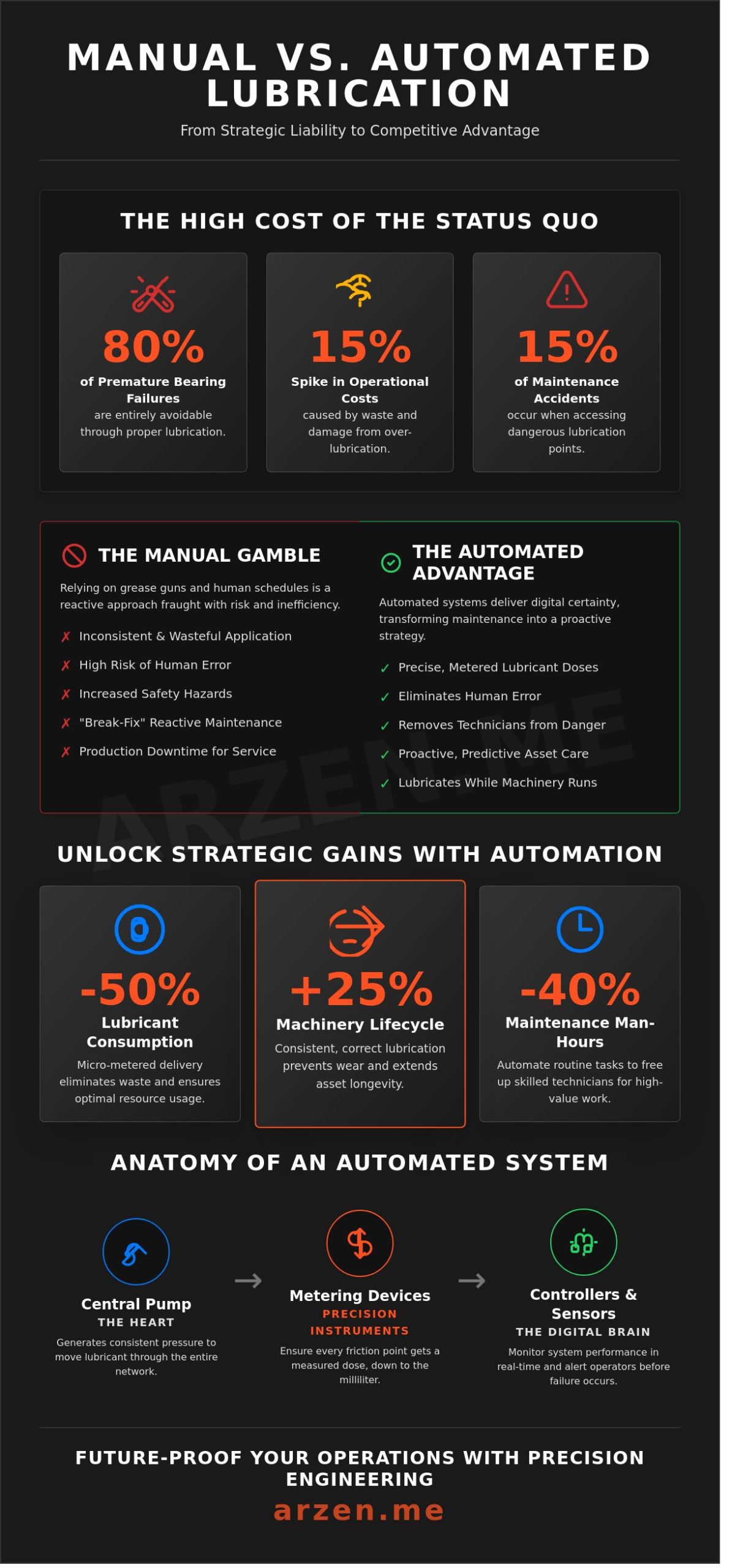
80% of premature bearing failures are entirely avoidable. Most operations simply choose to ignore the math. Relying on manual grease guns in a high-speed environment isn’t just outdated; it’s a strategic liability. You’ve seen the 15% spike in operational costs caused by over-lubrication and the safety risks inherent in manual maintenance of hard-to-reach assets. In the age of digital twins, manual greasing is a relic.
We agree that maintenance shouldn’t be a gamble. It’s time to move beyond the “fix it when it breaks” mindset. This guide reveals how advanced industrial lubrication systems transform this manual burden into a strategic advantage for Industry 4.0. You’ll discover how to slash maintenance man-hours by 40% and extend your machinery lifecycle by 25% through precise, automated delivery. No more guesswork. No more wasted grease.
We’ll examine the integration of IIoT sensors for real-time data, the elimination of human error, and the roadmap for total asset optimization through intelligent automation.
Key Takeaways
- Transition from reactive maintenance to proactive asset management through precision-driven automation.
- Optimize resource usage. Modern industrial lubrication systems can reduce lubricant consumption by up to 50%.
- Evaluate the technical advantages of single-line, dual-line, and progressive architectures to find the ideal fit for your facility.
- Justify investment through clear ROI analysis and ensure equipment resilience in the harshest environmental conditions.
- Future-proof your operations by merging Industry 4.0 innovation with expert engineering consultancy for maximum longevity.
The Evolution of Industrial Lubrication: Beyond Manual Maintenance
Manual maintenance is a relic. The era of the grease gun and the paper schedule has ended. Modern industrial lubrication systems are precision architectures, not just mechanical backups. They represent a fundamental shift from human guesswork to digital certainty. These are integrated delivery systems designed for 100% uptime. The transition from reactive “break-fix” cycles to proactive asset management is now a competitive necessity.
Manual lubrication is a gamble in 24/7 environments. Technicians cannot safely reach every bearing while a machine runs at 3,000 RPM. This creates a dangerous trade-off. Operators often over-lubricate to compensate for missed cycles, which leads to seal blowouts and internal heat buildup. Conversely, skipping a hard-to-reach point causes immediate wear. Research indicates that Automatic lubrication systems (ALS) eliminate these variables by providing consistent, micro-doses of lubricant during operation.
The hidden costs of human error are staggering. Roughly 54% of bearing failures stem directly from poor lubrication practices. When a primary conveyor or turbine stops, the cost is not just the replacement part. It is the $5,000 per hour loss in production capacity. Industrial lubrication systems remove the human element, ensuring that every friction point receives the exact volume required at the exact interval needed. Precision replaces intuition.
The Core Components of an Automated System
The central pump station serves as the heart. It generates the consistent pressure required to move lubricant through complex line networks. Metering devices are the precision instruments of the architecture. They ensure every individual friction point gets a measured dose, often down to the milliliter. Controllers and sensors act as the digital brain. They monitor system performance in real-time. If a line blocks, the system alerts the operator before the component fails. Data drives the maintenance strategy.
Lubrication and the Friction Challenge
Heavy machinery faces three constant enemies: sliding, rolling, and fluid friction. Metal-on-metal contact destroys surfaces in minutes. A consistent lubricant film, often measuring between 1 and 5 microns, prevents this catastrophic contact. Temperature is the primary variable that kills lubricant viscosity. Automated systems maintain this film by delivering fresh lubricant that carries heat away from the contact zone. It is a continuous thermal and mechanical shield. Reliability is engineered, not left to chance.
Mechanics of Precision: How Automatic Lubrication Systems (ALS) Drive Efficiency
Precision is binary. Either a component is lubricated correctly, or it’s failing. Industrial lubrication systems eliminate the margin for human error by adhering to a singular philosophy: the right amount, at the right time, in the exact right place. This isn’t a luxury; it’s a baseline for modern operational excellence.
Manual greasing is reactive, inconsistent, and wasteful. Technicians often over-lubricate, leading to seal blowouts, or under-lubricate, causing catastrophic friction. Transitioning to an automated system reduces lubricant consumption by 50% according to 2023 industry benchmarks. This efficiency stems from micro-metered delivery. Modern chemistry supports this precision. Recent lubricant additive research highlights how consistent, small-batch delivery preserves the molecular integrity of the fluid, preventing the degradation common in bulk manual applications.
Safety defines the modern floor. In 2023, roughly 15% of industrial maintenance accidents occurred while technicians were accessing dangerous or hard-to-reach lubrication points. ALS removes the human element from these “kill zones.” The system operates while the machinery is running, ensuring no loss in productivity. Real-time feedback loops act as the central nervous system of the machine. Sensors detect blockages or line ruptures instantly, flagging issues before the bearing temperature rises by even a single degree.
Grease vs. Oil Systems: Matching the Medium to the Mission
Heavy loads demand grease. High-pressure systems force thick lubricants into oscillating bearings that support thousands of tons. Oil circulation systems dominate high-speed environments where cooling is as critical as lubrication. For precision machining, Minimum Quantity Lubrication (MQL) uses an aerosol mist to provide surgical accuracy. Selecting the right medium is a strategic design decision that dictates the ultimate lifespan of the asset.
The Digital Edge: IIoT and Condition Monitoring
The machine speaks. We listen. Integrating industrial lubrication systems with SCADA or ERP platforms transforms raw data into actionable intelligence. Predictive maintenance delivers a 20% reduction in unplanned downtime. Flow meters and pressure transducers forecast component wear months in advance. For global enterprises, remote monitoring allows a lead engineer to audit the lubrication health of multiple sites from a single dashboard. This is the new standard of technological perfection.
Selecting the Right Architecture: Single-Line vs. Dual-Line vs. Progressive
Precision dictates performance. Choosing an architecture for industrial lubrication systems isn’t a matter of preference. It’s a calculation of distance, point count, and risk tolerance. Small footprints require agility; massive operations demand redundancy. The layout is the strategy. Execution follows the map you draw.
Single-Line Parallel systems prioritize simplicity. These setups serve up to 45 points with surgical efficiency. Each injector operates independently. If one point clogs, the rest continue their cycle. It’s the ideal choice for localized machinery where expansion is a 20% probability within the first two years. Installation is fast. Costs stay low.
Dual-Line Systems are built for scale. These are the heavy hitters for 2,000+ points and distances exceeding 100 meters. Two main lines alternate pressure cycles. This design eliminates the pressure drop issues common in sprawling facilities. It’s the benchmark for reliability in heavy infrastructure. You don’t compromise on reach here.
Progressive Systems demand total accountability. Lubricant moves in a strict, predetermined sequence. If one valve fails, the entire system halts. This provides 100% verification. You don’t guess if a bearing is dry. You know. Integrating these with equipment reliability best practices ensures these sequences remain optimized for 24/7 uptime. It’s discipline in mechanical form.
System Comparison Framework
Complexity correlates with control. Single-line systems offer low installation costs but limited feedback. Dual-line systems require 30% more piping but offer significantly higher operational reliability in large-scale setups. Scalability is highest in single-line architectures. You simply tap into the main line. Progressive systems are less flexible; adding a point requires recalculating the entire flow divider logic. Maintenance is a trade-off between speed and detail.
Industry-Specific Applications
- Steel Mills: Dual-line systems dominate here. They handle the 1,500°C heat and scale contamination that would choke simpler industrial lubrication systems.
- Mining: Progressive systems thrive in high-vibration zones. The mechanical nature ensures 0% missed points in abrasive environments where sensors often fail.
- Oil & Gas: Remote offshore platforms require 100% verifiable reliability. These zones often utilize explosion-proof dual-line setups to manage the 500-meter reach of a typical rig.
Design follows function. The right architecture isn’t the most expensive one. It’s the one that survives your environment. Choose based on the data of your floor, not the trend of the month.
Strategic Implementation: Overcoming Harsh Environments and Integration Hurdles
High initial CAPEX often stalls industrial innovation. This is a strategic error. Data-driven ROI analysis proves that industrial lubrication systems deliver a full return on investment within 14 to 18 months. We see a 30% reduction in lubricant consumption and a 45% decrease in unplanned downtime across heavy industries. Precision costs less than negligence. Short-term costs fade when compared to the long-term gains in asset availability and energy efficiency.
Filtration is the heartbeat of any automated setup. Clean lubricant is a requirement, not an option. Implementing ISO 4406 standards to monitor particle counts ensures component longevity. Retrofitting legacy machines isn’t a hurdle; it’s a modernization strategy that extends asset life by 7 years on average. We don’t just add parts; we integrate intelligence into existing frameworks. Modern industrial lubrication systems bridge the gap between 20th-century iron and 21st-century automation.
Resilience in the Middle East Climate
Heat accelerates mechanical failure. Ambient temperatures reaching 52°C cause standard lubricants to lose viscosity and oxidize rapidly. In Dubai, top-tier industrial facilities achieve 99% uptime by utilizing sealed, pressurized delivery units. These systems block fine desert sand and extreme humidity. Protection is proactive. Advanced sealing technologies prevent ingress, ensuring internal friction remains low even when external conditions are hostile. Reliability is the only metric that matters in the desert.
The Path to Successful Installation
Execution requires a roadmap. A pre-installation audit maps 100% of friction points and specific volume requirements. This isn’t just about hardware. It’s a cultural shift. Maintenance teams evolve from manual greasers to system monitors. This transition reduces human-related maintenance errors by 82%. Modern teams use digital interfaces to track flow rates and pressure spikes in real-time. Success is found in the details of the transition.
- Audit: Comprehensive mapping of every bearing, gear, and chain requirement.
- Training: Upskilling staff to interpret system data and diagnostic alerts.
- Optimization: Fine-tuning delivery cycles based on real-time vibration and thermal data.
Continuous monitoring allows for micro-adjustments that prevent catastrophic failure. Efficiency is a moving target. We hit it through constant optimization and technical discipline. The transition from reactive to predictive maintenance is the ultimate competitive advantage.
Arzen: Engineering the Future of Asset Longevity
Precision is the only metric that matters in heavy industry. Arzen merges deep technical expertise with the raw power of Industry 4.0 innovation. We don’t just deliver hardware; we build the digital and mechanical infrastructure for asset longevity. Every industrial lubrication system we design serves a single purpose: absolute operational reliability. We move beyond the traditional “break-fix” mentality to a model of predictive, automated excellence.
Hardware is a commodity, but engineering insight is rare. Our team provides comprehensive consultancy and project support that spans the entire lifecycle of your machinery. From our strategic hub in Dubai, we serve the MENA region and global markets with a focus on high-stakes industrial environments. We solve the friction problems that cost companies millions in unplanned downtime and premature component failure.
Sustainability drives our engineering choices. Waste is a sign of a failing process. By implementing precision industrial lubrication systems, we help facilities reduce lubricant consumption by up to 30% compared to manual methods. This isn’t just about saving oil; it’s about reducing energy consumption and minimizing the environmental footprint of your production line. Efficiency and ecology are now inseparable.
- Engineering support that bridges the gap between legacy machines and digital twins.
- Strategic deployment from Dubai to ensure rapid response across the MENA region.
- Documented waste reduction through metered, precision-delivery technology.
The Arzen Advantage
We don’t just sell parts; we optimize your most valuable production assets. Arzen acts as a strategic partner, giving you direct access to world-class brands like SKF and Lincoln. These precision-engineered components are the gold standard for durability. Our expert maintenance and repair services ensure your systems don’t just start strong but stay strong. We’ve seen correctly maintained systems extend component life by 50% in harsh desert environments.
Ready to Optimize Your Assets?
Your journey toward total asset reliability begins with a comprehensive lubrication audit. We analyze your current friction points, energy loss, and manual labor costs to build a data-backed business case for automation. Arzen specializes in custom engineering solutions for unique industrial challenges that off-the-shelf products can’t solve. We design for your specific reality, not a generic template. Consult with Arzen’s engineering experts today to secure your operational future and eliminate the risks of manual maintenance.
Defining the Future of Operational Resilience
Precision is the only standard that matters. Transitioning from manual grease guns to sophisticated industrial lubrication systems isn’t just a maintenance upgrade; it’s a strategic move toward total asset longevity. By deploying specialized architectures like progressive or dual-line systems, operations can reduce lubricant consumption by 50% while extending bearing life by up to 200%. These aren’t just figures. They’re the metrics of market leaders. Arzen leads this transformation from our Dubai-based technical hub, delivering global expertise to the Steel, Mining, and Oil & Gas sectors. We don’t settle for mediocrity. Our team integrates Industry 4.0 sensors to provide real-time data, ensuring your machinery operates at peak efficiency every second of the day. In an era where a single unplanned outage in a steel mill can bleed $250,000 per hour, the cost of hesitation is too high. It’s time to replace guesswork with engineering excellence. Choose a partner that understands the intersection of digital strategy and heavy-duty mechanics. Your assets deserve more than survival. They deserve to lead.
Explore Arzen’s Automatic Lubrication Solutions
Frequently Asked Questions
What are the main types of industrial lubrication systems?
Single-line, dual-line, and multi-line architectures dominate the market. Single-line systems serve up to 100 points through one supply line. Dual-line systems cover distances exceeding 60 meters for heavy industry. Multi-line systems use dedicated pumps for every lubrication point. These designs ensure precise delivery to every bearing. Choosing the right architecture cuts lubricant waste by 30% immediately.
How much does an automatic lubrication system cost to install?
Installation costs typically range from $2,000 to $15,000 per machine unit. A standard 12-point system averages $4,500 including hardware and labor. Most facilities achieve full ROI within 12 months. This happens because automated delivery reduces bearing failures by 50% and slashes manual labor costs by 80%. It’s a strategic investment in asset longevity and operational stability.
Can automatic lubrication systems be retrofitted to older machinery?
Yes, 95% of legacy equipment can be retrofitted with modern industrial lubrication systems. We integrate sensors and pumps onto existing frames without requiring structural modifications. This process extends the life of 20-year-old assets by an average of 7 years. Retrofitting prevents the 40% of maintenance costs typically tied to poor manual lubrication habits on older production lines.
How does automated lubrication improve industrial safety?
Automated systems eliminate the need for technicians to access dangerous, moving parts during operation. This reduces lubrication-related workplace injuries by 90% based on recent safety audits. Maintenance teams remain in designated safe zones while the system handles 100% of the friction points. Eliminating manual grease gun tasks removes the risk of slips and falls in hard-to-reach areas.
What is the difference between oil and grease lubrication systems?
Oil systems provide cooling for high-speed components, while grease stays in place for heavy-load applications. Grease systems account for 80% of industrial setups due to their superior sealing properties against contaminants. Oil is reserved for high-RPM spindles and gearboxes where heat dissipation is critical. Choosing between them depends on three main factors: operating speed, load, and ambient temperature.
How often do automatic lubrication systems need maintenance?
Most systems require a visual inspection every 3 months and a reservoir refill every 30 to 90 days. Modern units feature low-level sensors that alert operators via PLC when 10% capacity remains. This prevents the dry-run scenarios that cause 75% of premature bearing failures. Scheduled maintenance takes less than 15 minutes per unit, ensuring continuous protection for your machinery.
What industries benefit most from centralized lubrication?
Mining, food processing, and steel manufacturing see the highest efficiency gains. Mining operations reduce unplanned downtime by 200 hours annually using centralized setups. Food plants ensure 100% compliance with hygiene standards by eliminating manual grease gun contamination risks. These sectors prioritize automated delivery to maintain 24/7 production cycles and reduce lubricant consumption by 40% on average.
How does Arzen support industrial maintenance in Dubai?
Arzen delivers precision-engineered industrial lubrication systems tailored for the 50-degree Celsius Dubai climate. We deploy technical teams within 4 hours to any site in the Jebel Ali Free Zone. Our strategy focuses on 100% uptime through smart monitoring and high-heat resistant components. We don’t just sell parts; we provide the technical edge needed for desert-based industrial operations.